

Amy DeBellis
fiction
Smoke and Salt
Written by Amy DeBellis
Irene had missed them all: first day of high school, prom, freshman orientation, first day at her job. Or, not missed them exactly, as she’d dutifully shown up to these events, but rather the opportunities they presented. Each represented a new beginning of sorts, a chance to orient herself against a madly spinning wheel of variables and deftly pluck from it these things necessary for an enjoyable life: friends, acquaintances, a reputation, a future, a past.
She’d missed all of these chances. Whether it was school or university or her job, she’d always kept her head down, done her work, and gotten out of there. As though the entirety of her life were a class to be suffered through until the final bell rang.
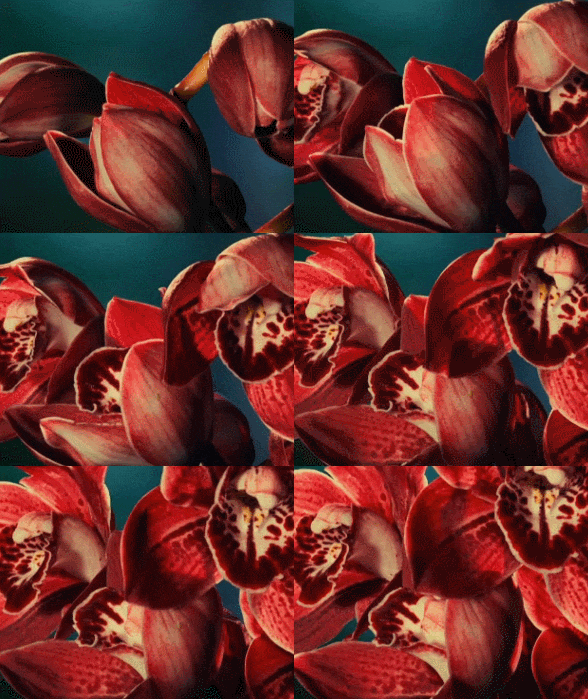
But now, in her budding relationship with Joseph—a relationship which she had, much like her current job, fallen into by luck or by accident—she sensed another chance. It was New Year’s Eve, and his best friend was throwing a party. What went unspoken: she would meet Joseph’s friends for the first time. She would not disappoint them. She would finally, finally bloom. She would be iridescent, like some rare species of flower, like a slipper orchid or a flame lily or a luminous jade’s vine.
Even an ordinary daisy, really, would be good enough. Anything but a weed.
~
At nine p.m., Irene slipped into the silvery-white dress she’d bought for the occasion: spaghetti-strapped, a cowl draping elegantly above her breasts, silk sliding over her body like water. She regarded herself in the mirror, which was so small she couldn’t see anything below her waist. But she could see enough: the dress flattered her shape without clinging. It made her long neck and bony chest look regal instead of ratlike, and somehow, by some magical shift of color, managed to bring out the pale blue in her eyes instead of their usual watery gray shade.
She gave herself a tiny smile. Ghost orchid, she thought. Sea daffodil. Water lily. The dress even felt like a flower petal.
Joseph stepped out of the bathroom, already taking a puff from his vape. When he saw her, he raised his eyebrows. “You’re going in that?”
“Um…yeah?” Irene twisted around, trying to see her ass. “You can’t see my underwear, can you?”
“No, it’s not that. It’s just a little…revealing.”
“It is?” The dress hit below the knee. Then she remembered the spaghetti straps, the bare arms. “I mean, I’m not gonna get cold inside, right? It’s not like we’re going to Times Square to watch the ball drop.” (Although if they were to embark on that lunatic scheme, she’d at least have the crush of hundreds of strangers, some of whom had peed in their pants, to warm her.)
Joseph appeared not to have heard. “Turn around again?” he asked, like he was trying to assess something.
She complied, trying to psych herself up for the task of going commando. It wasn’t like anyone else at the party would know. It just wasn’t the sort of daring thing Irene usually did. Although if it was what she had to do to get away with wearing this dress without showing panty lines, she’d gladly do it. It had cost two hundred and fifty dollars, and right now it gleamed, it hugged her like the softest casing imaginable.
“Yeah, no, it’s showing your whole back.” Distaste curdled on his face as he brought the vape pen back to his lips.
She examined her back in the mirror, the slight muscles rippling as she moved. The fabric didn’t even dip below her shoulder blades. “Hardly my whole back.”
“It shows your mole,” he said impatiently, through an exhale of blueberry smoke.
Something cold formed in her stomach.
“My mole,” she repeated, turning the words over in her head, where they clattered against her skull, grew bigger and bigger, took up all the space there.
“You know I’m not a fan of moles.”
And she did know that. He’d hinted as much, on the beach, half a year ago. They were lying on their towels, tanning after a swim in the ocean. Head hazy with sunshine, Irene was turning over, sighing with contentment, to get some sun on her back. What’s the point of getting a tan on your back when you cover it up anyway? he asked her. What do you mean about covering it up? she replied, genuinely confused. He frowned. Because you don’t want people to see your mole, right? She didn’t know how to reply to this, and after a moment he only shook his head and put his head down on his crossed arms, the same way she was doing, but looking the other way.
For some reason she’d forgotten. Had gotten so wrapped up in the dress, the desire to waltz into the New Year’s party and make an impression for once, that she’d let his words on the beach slip away like the remembered salt air, the blazing white heat of the sun, the texture of the sand.
Joseph came closer, breathing fake-blueberry scent into her face. His pupils were small and hard. “Your skin looks rough,” he said, taking one of her arms and bending it gently so he could see her elbow. “Why are your elbows so dry?”
She pulled her arm back, rubbed her elbows self-consciously. They felt like bark and were indeed so rough that they produced a faint rasping sound under her fingertips. She’d been slathering lotion on them each night before bed, but it hadn’t had any effect so far.
“I don’t know,” she said. “Skin just gets dry in the winter.”
“Mine doesn’t.”
It was true. Joseph never had dry skin, at least not like this. His genetics were faultless. He had never needed braces or glasses, or even deodorant, because he literally did not seem to produce body odor. He was six foot four—his height a gift whereas hers, at five eleven, was an embarrassment.
“Like sandpaper,” he said, reaching for her elbow again. “It makes a noise when I rub it. Jesus.” He regarded her dispassionately, his eyes darting again to the mirror, where her mole stood out against her pale skin. “You should cover it up, Irene. Your body isn’t made for dresses like that.”
His last sentence was like a hallway with all the lights turned off and a door shut at the end.
~
The subway was full of revelers, many of them drunk or high already, hanging off the railings and chattering with unspent energy. Silver and gold and glitter and sequins sparkled everywhere Irene looked, like she was inside a gigantic jewelry box. Sitting next to her, Joseph scrolled on his phone. He was all gold: gold rings, gold T-shirt, gold streaks in his hair from a temporary dye kit. Pure gold. He caught her looking at him and gave her a loose, innocent smile. He’d smoked a joint right before they left, and the marijuana had slurred the vicious bramble in his mind, softened the thorns.
Irene smiled back at him, mouth unmoored from her eyes, and thought: You’re not pure gold, you’re just gold plate. Rubbing off into copper, leaving a green stain on my finger.
To distract herself from the itchy, prickly feeling of the gray dress, she thought back to the last time they’d gone to the beach. Early September, still warm. Joseph hadn’t said anything about her mole then. (She’d brought a T-shirt to wear when she wasn’t swimming.) They’d stayed so long the sun had begun to set. The sand was soft beneath her feet, her skin as brown as it would ever get. She took great lungfuls of air, closed her eyes and tried to imagine that she was the only person at the beach. She could almost believe it. It was incredible, this trip, although she couldn’t describe how or why. It lingered in her memory like a myth.
Someone pushed past Irene’s legs, and she jolted back to the subway car. Everyone around her in lunar silver and luminescent gold and she was wearing gray. The color of ashes, of death. She tugged the sleeves down, so they covered her palms, even though there was nothing ostensibly wrong with her hands. (Perhaps Joseph would turn his gaze on them next, would say that they had too many lines or something.) When they got off at the next stop, he walked a step ahead of her without even seeming to notice he was doing it, like he was lost inside thoughts of his own essence, his own grandeur, and she had to scamper to keep up.
~
The party was already blazing when they walked in. Noise assaulted Irene from several different sources: the clinking of glasses, laughter, music blaring from a speaker, delighted shrieking, and underneath it all the murmur of softer conversation. There didn’t seem to be a single blank space in the apartment—every inch of wall seemed covered with a painting or an appliance or someone’s body leaning up against it. There wasn’t, of course, a single silent moment. Everything was full, full, full to bursting.
Joseph wasted no time in greeting his friends, a rush of faces that Irene barely registered. And as for their names, it was useless to even attempt to remember them. They flashed by her like names of subway stops she’d never get off at. She hitched a smile onto her face—this smile was heavy tonight; she was going to have to work hard not to let it droop—and tried to look pleased to see them.
All the while, the scratchy fabric of her dress rubbed against her body. When she moved her arm she could, to her horror, feel it catching on the rough skin of her elbow. Sandpaper, Joseph had said. She wanted to scrub her skin with handfuls of real sand, wade into the ocean and let the salt soothe the itch that had traveled across her back, her chest, her arms.
Standing by the wall, Irene found herself squashed between Joseph, who was now talking animatedly to his friend on his other side, and some woman with shaggy hair. The woman smiled at Irene. She was wearing a slinky silver spaghetti-strap dress, almost the same as the one Irene had wanted to wear, except for the fact that it was covered in sequins. They shifted like tiny mirrors whenever she moved. “So where are you from?” the woman asked.
This was it. This was her chance. Irene named her town, but of course the woman didn’t recognize it. Irene followed it up with the state, and the woman nodded, although some interest had already flickered out behind her eyes.
“Where are you from?” Irene asked, desperate to steer the conversation to more interesting waters. She could feel the smile plastered across her face: too wide, rabid.
“Chicago.”
Irene had never been. She flicked through a list of associations in her mind: bitter cold, the Great Lakes, sports teams she had no idea the names of. “Oh! That’s cool.”
The woman was still smiling, but her eyes were now as dead as guttered candles.
“My mom went to Chicago once.” Irene was talking too fast. “She said one of her friends went outside one day, and it was so cold his glasses froze—they shattered!”
“Mmm,” the woman said, nodding, and her gaze flickered across the room.
How did people have conversations? Where was Irene’s instruction manual? It was easy enough at her hostess job—all she had to do was determine how many people needed to be seated, grab the requisite number of menus, and lead them to a table with a smile and an invitation to enjoy their meal. The script never changed. But this? Every question might lead to an awkward pause, an answer she wasn’t supposed to give, an aside no one wanted to hear. This was like trying to juggle knives in the dark.
Joseph came over to her a few minutes later. The woman had mercifully departed for a more affable companion. “Could you look any more depressed?” he muttered into her ear. “It’s New Year’s. Can you at least try to smile?”
“I have been smiling,” she said, surprised.
“What do you think of my friends?”
“They’re nice! They’re really cool.”
If he decided to quiz her on their names, she’d drown herself in her plastic cup of champagne. But he didn’t. He started telling her about Michael’s recent moneymaking idea—well, she had one name now, although it wouldn’t do her much good, as she had no idea to whom it belonged—and she nodded and smiled, content with just listening. Eventually he walked away to join a knot of friends, and she watched him from across the room. Laughing, socializing, never once struggling.
Just past eleven, Irene spotted the shaggy-haired woman from Chicago on her way to the refreshments table. They made awkward eye contact, and Irene took off across the room as though branded, trying to look as though she were on her way to a long-lost friend she’d forgotten about. During the next hour she walked quite a bit. Weaving her way in and out of groups of people. Never standing alone for too long. Her cheeks began to hurt. Her feet began to hurt. She had done this, too, at prom.
~
Every twenty minutes or so, she sought refuge in the bathroom. Alone at last! But no, not alone—she still had her body with her. Unthinkable body, unthinking brain. She pulled her dress off and for a few minutes she just scratched: doglike, single-minded. She’d throw this hellish dress in the trash when she got home. Would pour bleach over it so Joseph wouldn’t be able to rescue it.
She turned around, baring her naked back to the mirror. There was her mole, standing out like a tiny dark planet in a universe swollen with light. She reached around as far as she could, hugging herself, pressed her fingernails into the mole until her eyes watered with pain. Then she rubbed her elbows over and over, grinding her fingertips against the rough skin. Rubbing and rubbing as though she could, by the time the red-eyed morning came, sandpaper herself—all her missteps, all her shames, all her ineptitudes—away to nothing.
~
Coke lined up on glass tables, people snorting it through rolled-up dollar bills. Joseph, wary of the chemicals in paper money, used strips of paper he’d taken from home. A few minutes later his pupils had blown so big they swallowed the irises.
Irene didn’t do any coke. She’d already established herself as a loser, so there was no point in subjecting herself to paranoia and anxiety—effects she’d experienced the one time she’d tried cocaine—just to try to fit in.
The exotic flower had not, in the end, made an appearance. Hard to do so when suffocated with a dress the color of storm clouds, a carapace that stretched from collarbone to wrist to knee. Instead, it moldered unseen. Petals darkening, stiffening, curling inwards in a reverse bloom.
~
Finally, the countdown. “TEN! NINE! EIGHT!” People were standing on the couch, holding each other’s hands. Joseph was nowhere to be found. The noise seemed to reach the stars. “THREE! TWO! ONE! HAPPY NEW YEAR!” Everyone around her embracing. And then Joseph crashing to her side in a rush of glitter—he had added more gold, sparkles ringing his eyes—saying “Sorry, sorry, it’s still a few seconds before midnight a few miles west of here,” and even though this wasn’t technically true she laughed at his wit, the roguish charm she’d first fallen for, and leaned into his kiss. And suddenly she was remembering other kisses with him, ones that now seemed a lifetime ago in the coil of time. Ones where his pupils were normal-sized and he cradled the back of her head in his hand, running his palm over the contours of her skull like he’d do anything to protect what was within. Ones where he was amazed that she could tell him of her affection in five languages, amazed that you could find her poetry collection in bookstores, amazed at how well she could cook a lamb curry. Back then: only affection present on the surface, like light glittering pristine over water, and only fractured by the occasional ripple. Days slipping, now, from sight. Slow bruise of memory.
~
At last it was time to go. The elevator tended to lag, and the party was only on the third floor, and Joseph wanted to show off. His eyes were big black holes. His jaw was clenching and unclenching; Irene imagined him waking in the morning with his teeth ground down to nubs.
“Irene!” he called, grinning. “Lemme show you guys something.” He knelt down at the top of the stairs. “Come on, hop on.”
Everyone watched them from the open door of the apartment. Gingerly, Irene put her arms around Joseph’s neck. It was a bizarre feeling. She hadn’t ridden piggyback since childhood. Vague memories of her mother racing around the living room, Irene’s tiny body bouncing against her spine, both of them delirious with laughter.
“No, not like that. Sit on my shoulders!”
The partygoers cheered, as though they were one being.
“That’s so dangerous,” she said quietly, not wanting to humiliate Joseph in front of his friends. But already fear had turned her sober. Balance on Joseph’s shoulders while he walked down the stairs? It was suicide. The steps unspooled below them, leading down and down and down, a precipitous cliffside. “You’ll break both our necks.”
“No, I won’t. Come on. Don’t you trust me?” His grin was fading, and he looked almost melancholy. Almost sweet. “Trust me.”
“I don’t know if it’s a good idea…”
From the open doorway, the partygoers could see their hesitation. Someone shouted, “C’mon, Joe, don’t be a pussy!” and something behind Joseph’s eyes hardened.
At that look, Irene eased herself down onto Joseph’s muscular body. Right leg over his right shoulder, left leg over his left shoulder. He stood up, and she shrieked. “Calm down,” he laughed. Back in his high spirits. His hands were firm and sure around her thighs, locking her in place. He was very strong, she knew. He could deadlift four hundred pounds, could support her weight without wobbling.
Maybe this won’t be so bad, she thought.
And then he started to walk down the stairs. He took one step, and another. Irene’s stomach swooped, then plummeted like a stone. She gripped his hair, desperate for something to hold onto, but he shook his head irritably. “Jesus, Irene, I’m not a horse.”
His friends heard that and howled.
Joseph descended another step. Her torso felt like something weighted—which of course it was, it probably weighed over fifty pounds. The vertigo was extreme, the sensation that if she let herself tip backwards, she would cause them both to go crashing down, whacking her head on the floor behind them. And if she leaned forward, even a bit, it would be much worse: Joseph would careen down the stairs, probably breaking both wrists, and she’d fall from a far greater height, tumbling in the air like a doomed gymnast, landing on her head. Her skull cracked, all of it wet and open against the white marble of the floor, an egg filled with blood.
To her right was blank wallpaper. To her left was the railing on the third-floor landing—curling metal balusters holding up a smooth wooden banister, the wood dark with oil from people running their hands over it. She could see the partygoers’ feet through the balusters, like they were the bars of a cage. The railing was at chest height now, but as Joseph took another step down, it began to rise out of reach.
More out of instinct than anything else, she reached out and grasped the thin metal bars of the balustrade. Anchoring herself to it. Now she wouldn’t tumble down. She wouldn’t fall ass over head and break her neck on the unforgiving marble, crumple dead or paralyzed.
Joseph took another step down and felt the weight on his shoulders start to pull away from him. “Hey!” he shouted, twisting out from under her legs, which were now dangling in midair. “What the fuck are you doing?”
She had no answer. She could only cling to the balustrade and lower herself to the steps. She sat there, trembling, her mouth coppery with adrenaline. Sweat was flooding her chest. Her face was hot with panic.
There was no more laughter or hooting or teasing from the partygoers. The door was still open, but when Irene chanced a glance up, they were only watching in fascination. She had humiliated Joseph after all.
“That’s so fucking dangerous! I seriously can’t believe you just did that, Irene, what the fuck? What are you trying to do, kill me?”
What were you trying to do, kill me? she thought.
“Why couldn’t you just say no?” His anger was giving way to exasperation. “If you were scared to do it, why couldn’t you just…say…no?”
“I tried!” But even as she spoke them, the words struck her as so weak that she swallowed the ends of them. Drew them back into her mouth, as though she were inhaling a trail of sharp-tasting vape smoke. The kind that smelled faintly like someone’s idea of blueberries—but not the real thing, no, never the real thing.
~
That day on the beach, that last day. And what had been so incredible about it after all was not the fact that it was the last day of summer or that he hadn’t made a comment about her body. It was that at last she’d felt alone.
Yes, Joseph had been there, sprawled out on the towels, but the other beachgoers were few and far between. As the sun dipped lower and lower in the sky, the last stragglers began to trickle away, gathering up their radios and baskets and flip flops and leaving only cigarette butts stubbed out in the sand. And as she’d waded into the water—not looking back at Joseph, hardly even caring, for once, if he was there—she felt a sense of lightness, of freedom. She truly believed that if she turned around and he had vanished, she’d be happier. The cool of the ocean lapped at her thighs, embraced her, and she slipped into the rift between two waves, slicing through the water.
The sun refused to set. Its light sluiced across the high crests of the waves. Salt filled her hair, crystallized on her skin. She turned her face to the sky, inflated her lungs with air, and let herself float. Let herself admit that this was all she wanted, now, from life: sun doorstoppered on the horizon, blinding tide, a drift of salt.

instagram | threads | facebook | duotrope | chill subs
LOVED this story... so many feelings. Well done, Amy!
I love the dense lyrical prose. Smoke and salt are strong psychological elements. Thank you for the story.