

Lilly Frederick
creative nonfiction
Third Generation Citrus
by Lilly Frederick
I learned to speak the language of oranges before I learned to talk. The familial, romantic, platonic love language of the orange. It’s the only way I know how to unconditionally show my love. When I am with my family, I never eat an orange in its entirety. It is the one act at which we are selfless. What a beautiful thing—to share food without a second’s hesitation.
It is a ritual to peel an orange. When the fingernail of my thumb pierces the rind of the orange, the pith lodged deep under the nail, I know that I will need to scrub extra hard when I wash my hands to remove all remnants of the white flesh. Even then, the bright scent of citrus will linger long in the grooves of my fingerprints. The ritual of peeling an orange is the painstaking dismemberment of the membranes because I hate the texture of those thin strings between my teeth. It is the juice of the orange dripping down my wrist, coating my hands in a sticky residue. Sometimes the peel unwinds in one long strip; other times it comes off torn in jagged chunks, mangled flesh tossed carelessly in the trash can making a soft pift as it hits the bag.
The ritual of peeling an orange is the conversation between my mom and sister while I stand over the trash can in the kitchen when dinner is being cooked. When I wordlessly feed my sister a slice because her hands are busy helping my mom peel potatoes and I notice a divot in the juicy pulp from my fingernail. The ritual is an imperfect expression of consideration. The ritual is one slice for me, one slice for you. How was your day? Did you get toilet paper?
I love you. I love you, too.
I think of my grandfather when I peel oranges. I always had, even before he died.
My grandfather loved oranges. All citrus, really, but oranges were his favorite. It’s a gene he passed along to all of his children and them to their children. I am a third generation citrus hidden beneath human skin.
I cannot count the number of times I returned home from school to find my grandfather in the chair by the window, one finger tapping on the screen of his phone, the television droning on mindlessly in the background, and he’d say: “I bought satsumas. They are especially good today. You need to eat one.” This news was so important, he’d bypass his hello to say it.
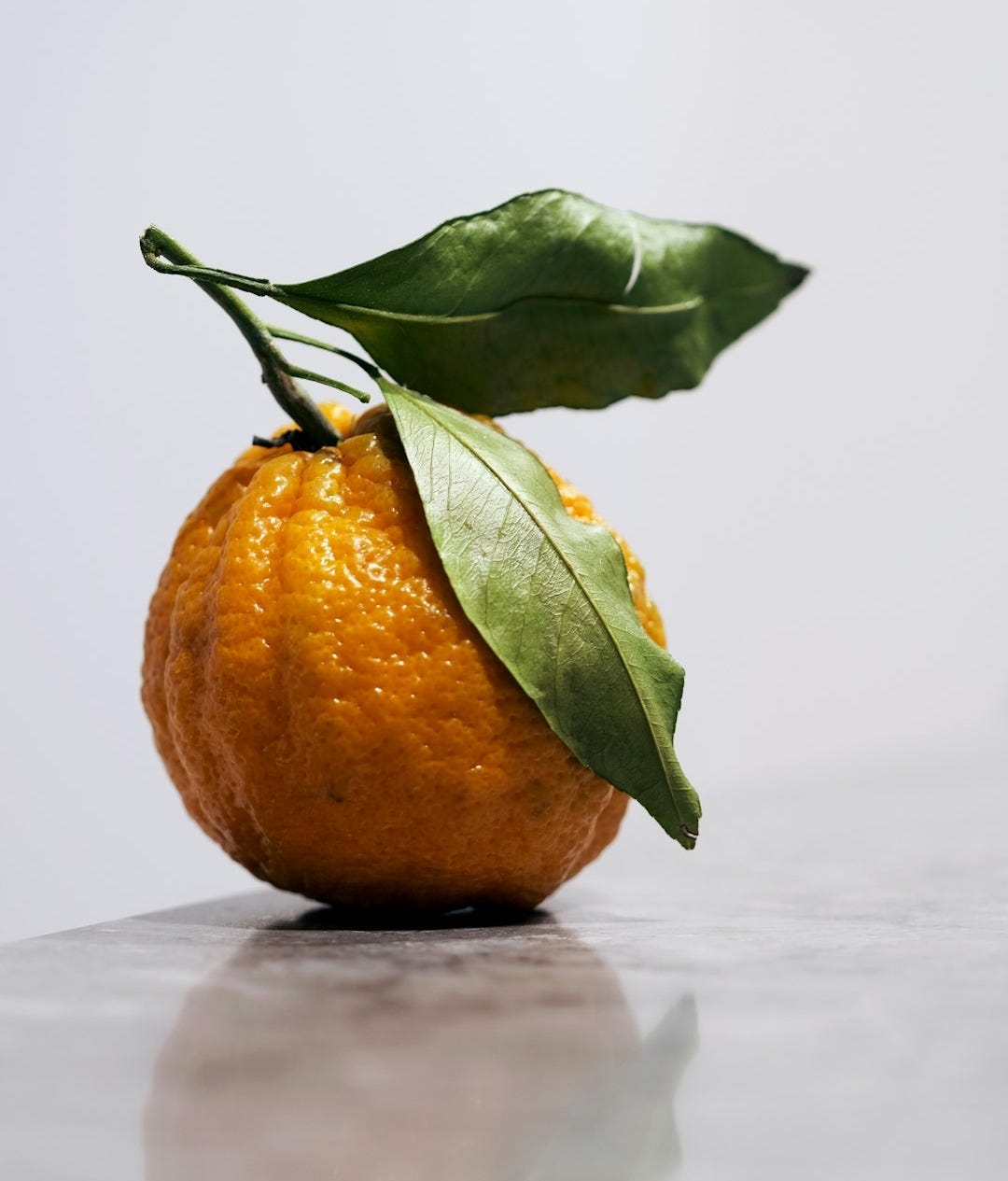
Satsumas were his god-tier oranges. They are deliciously sweet, but admittedly, I never enjoyed them because of the texture of the rind. The rind adherence is something I picked up as a child who found something absolutely unsettling about the wrinkly texture and bulbous growth at the peduncle. I preferred navel oranges, perfect when chilled and garnished with salt. There really isn’t much of a difference between the two types of citrus at their core—just a difference in the sweetness—and yet if my grandfather read those words, he’d roll over in his grave.
I’ve always thought my grandfather looked rather like a satsuma, too. He was a large man with a wrinkled belly; he had a permanent notch on the top of his balding head that he never could remember how he got it. And he was always especially sweet—a generous person who knew how to make others laugh and never met a stranger in his life. As his opposite, I was a navel orange. Smaller and sweet with a little tartness in me. Sass or anger or fire always mixed in with the kindness he also passed along to me.
My grandfather, however, was a satsuma bruised with time. The one at the bottom of the stack—slightly dented, a little too soft from a good life well lived, cut short from renal cancer of the lungs. If you peeled his rind, his fleshy insides were black and moldy. The cancer inside drained the life juice from his concaving form.
At the end of his life, his body shuddered with wet, bloody coughs. Alongside his hospice bed sat a large, long tube coated in thick, congealed blood that was used to clear a space in his esophagus. Blood too thick to swallow. The tool reminded me of the one dental assistants use to suction water out of my mouth when doing a cleaning.
He was given morphine and a host of other drugs to keep him out of pain. It made dying easier for him, I was told by his doctor. His death was no less painful for me.
—
I said goodbye to my grandpa when he was being carted out of his hospital room to the waiting ambulance outside, ready to transport him home on comfort care so that he could die in the peace of his house. Only, I didn’t know then it was the only chance I’d get to say goodbye.
As the EMTs wheeled him out, I said “I’ll see you at home, dude.”
He replied, in a tone that seemed, in the moment, confusingly peppy, “I’ll see you, dude.”
I understand his tone now. I get his words. It was his half of the goodbye of which I was unwillingly part. My grandfather was happy to leave the hospital. He was ready to go quietly in his sleep. However, it was no quiet affair.
His death was a cry around thirty past midnight. A hoarse “Help! Help!” It was a conversation I couldn’t make out from behind the closed door of the bedroom I slept in—my mom talking to my grandpa. Another voice joined in and I could hear from the register that it was my aunt. His death was an opened door, light pouring in.
“What’s going on?” I asked my mom. Sleep pulled the words from my mouth in slurred sounds.
“Where’s the morphine?” she asked.
“In the bathroom.” I watched her through the open door rifle through the various medicines on the countertop in the bathroom, where we kept the more serious medicines so that we didn’t accidentally administer a stronger drug than needed, until she found the bottle of green liquid she was searching for. “He needs it?”
“Yes. He’s in pain breathing.”
My grandfather’s death was the quiet of the room after my mom left, the door closed behind her. Some coughing and the voices resumed. Then it was silent. His death was my curiosity getting the best of me when I should’ve stayed in that bed. It was the single light next to the hospice bed, next to which my mother and aunt stood on either side, watching my grandpa’s labored breaths.
“Is he okay?” I asked. I was at the foot of his bed, then. My mom and aunt both held onto his hands, watching him and watching his face. I thought if we formed a barrier between him and the rest of the world, if we surrounded him, nothing could hurt him. Not even the cancer inside him.
It was a fruitless thought.
While my mom and aunt watched his face, I watched my grandfather’s chest. The way it heaved. His shuttered breaths. Watching his chest was easier than looking at his face. So, I was watching it when it puffed once and then collapsed on itself. It didn’t move again. I watched my grandfather take his last breath. Witnessing someone die is a grotesque, body numbing event even when the death does not occur from a grotesque accident.
His death was the exhausted chaos that followed—feeling his chest, holding a finger and then a mirror under his nose in an attempt to feel or see his breath because none of us were able to face the truth: He was dead.
His death happened too quickly. His doctor had informed us that morning that my grandfather had probably a week left to live once he was put on comfort care.
He lasted nine hours.
Once we’d acknowledged he was actually dead and once the EMTs, who we called out of confused panic, confirmed his time of death, we unplugged his medical grade oxygen tank and that awful suction tube. We sat in the screaming void of silence that was left in the absence of their motors. We sat while we watched the hospice nurse, whom we’d called after the EMTs left, dressed and made presentable my grandfather’s dead body.
His body was a dehydrated orange, stiff and shriveled.
I didn’t like looking at him, even after the nurse had pulled a shirt over his torso and pulled the blanket pulled up to his elbows. She said he could be sleeping, but despite her best efforts to make it easier to look at him, she couldn’t fix his face. Rigor mortis had already set in, face frozen in his last moments of life. Open mouth, head thrown back. There was a slight furrow in his brows. His skin was waxy. He looked in pain.
I kept my eyes resolutely on everything besides his body. It disturbed me to see him like that. His wasn’t the first dead body I’d seen—I’d been to an open casket funeral before—but it was awful nonetheless to see my grandfather dead.
I lie to myself to this day by believing that just because he looked like he died in pain, didn’t mean he did. It helps me keep that image of him out of my mind.
—
By the time the on-call funeral home workers showed up to collect my grandpa’s body, both in polos tucked into their pressed khakis, dressed as if it weren’t two in the morning, I was distressed. It had been an hour since my grandpa died, and we’d sat in that living room with his dead body the whole time. While my aunt and mom took their time to say goodbye to his corpse, I resolutely didn’t get near it.
I hated that I had to look so long at the body that my grandfather’s soul once occupied. I didn’t know until that tumultuous evening that I felt so strongly about dead bodies, or souls.
The body of my grandfather was just the vessel for who he was. I didn’t look at his body and see the man who took me around the country on road trips for fifteen summers. It wasn’t the man whose sweet tooth rivaled his love for his family. The man who, once he retired from thirty-plus years in the Navy, took a job as a traveling salesperson with his wife for Garlic Festival Foods. The man who showed his love through nightly homemade dinners on the table. The man who taught me what it means to be selfless by peeling oranges for me and him to share.
The body on the hospice bed no longer held him.
I had reached my breaking point, could no longer stand to be in the same room as his corpse, when my mom and aunt asked the two funeral home workers if they had to bag his body immediately or if they could have another hour with him.
I exclaimed, without thought, “I want that body out of this home, now!”
I don’t regret the words. I’m not proud of how, in the aftermath of my carelessness, voice raw with distress, my mom and aunt flinched at my blatant pronunciation of “that body.” But I don’t regret speaking my truth at that moment; I was going to lose my mind if I had to continue to hang out with a corpse that was hardening and losing color. The body wouldn’t get prettier, and neither would my attitude.
My mother and aunt had more grace than I did, and, reluctantly, they let the funeral home workers take my grandpa then, without getting their desperate final hour of goodbyes.
I watched as his body, wrapped in an American flag body badg—an act of honor the local funeral home did for veterans—was wheeled out into the dark of the night.
I didn’t feel my grandfather anywhere.
His soul, when it left, left quickly.
—
Four days after my grandfather’s celebration of life, we did not call it a funeral, I arrived at work to a bowl of oranges on the conference room table.
“I picked them with my son this weekend in Georgia,” my coworker said when she saw me eyeing the bowl. “They’re satsumas and they’re delicious. Have you ever had one?”
My grandfather was more like a father to me. He lived with me for most of my young adult life, along with my grandmother. He was a reliable, steadfast person. Someone I counted on—whether it was to pick me up from after school daycare when I was a child to showing up for every major event in my life. He always was there. He was someone I could confess fears and worries to, and was one of the first people I told all of my good news to. Life without him was inconceivable to me—the thought of him dying, even when he got sick, was an abstract idea, so facing his death head on, and in fact witnessing it, was unfathomable. That horrible night feels like a fever dream, and it remains one of the worst days of my life.
However, showing up to those satsumas at work felt like a wink from him. He isn’t alive, but the memory of him will never fade. He is the lingering tang left behind on my fingers after I’ve completed the ritual of peeling an orange
I did not eat a satsuma when my coworker offered me one. I haven’t eaten a satsuma since before my grandfather died. That god-tier orange belongs to him. There are, however, navel oranges in my fridge. When I slice into it tonight to eat as my after-dinner treat, I will think of my grandfather.
After all, I am a third-generation citrus in human form.

instagram | threads | facebook | duotrope | chill subs
Love this piece so much. Every word feels like barely restrained sorrow. Beautiful prose. Thank you for sharing.
Thank you for sharing beautiful story telling and what a colourful way to do it using satsuma .